
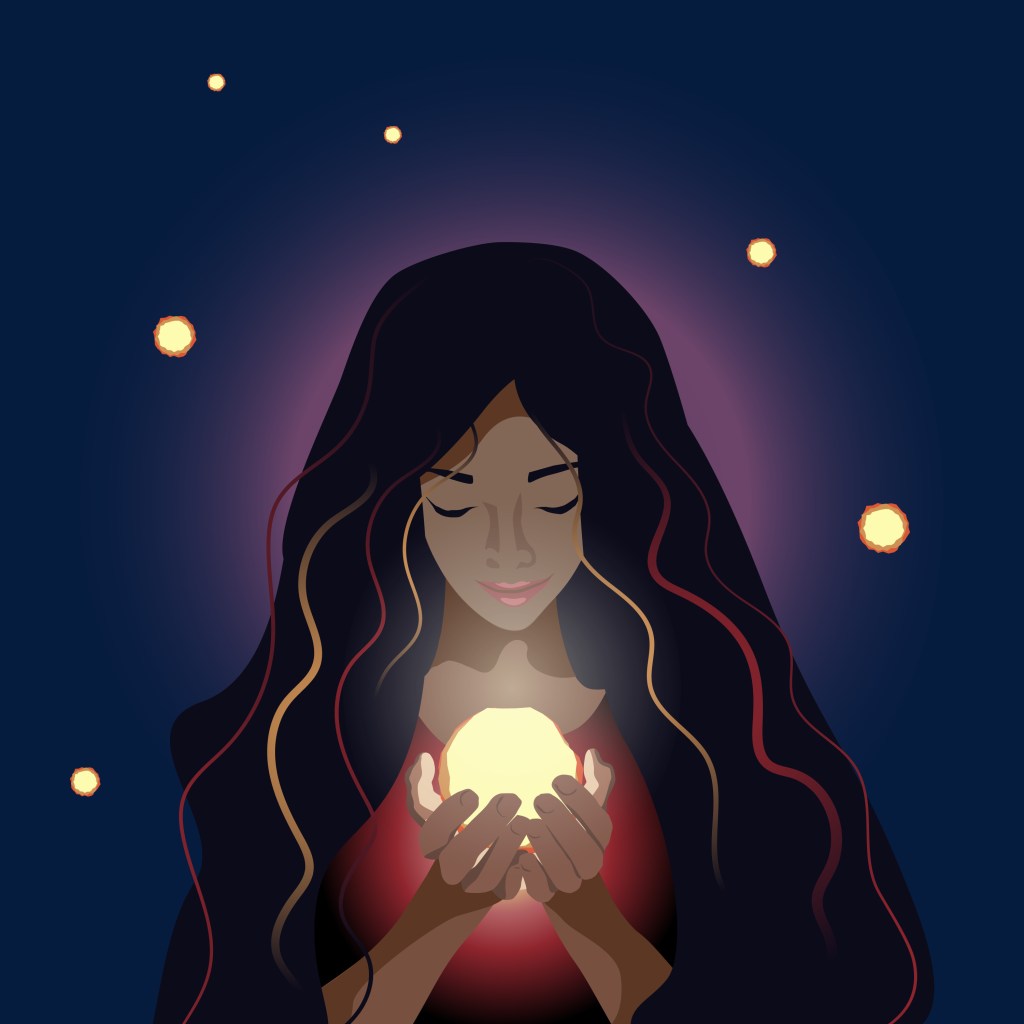
Over the next few cycles of day and night, I found myself distracted. I thought often about Ouranos and wondered whether he would eventually stop caring, stop protecting us. It would leave me and the children exposed to Khaos to do as he wished. The new creatures we had made were good, but I had to admit I still wasn’t sure where everyone fit. Were we really safe? Would enough of Khaos’s power get through Ouranos’s heavens? Would my fearsome children protect us if Ouranos didn’t?
So many questions without answers.
“Mother, you’re not listening!” Rheia complained.
We were standing together with Tethys where they had been showing me some new things they were doing with the fresh water and the earth. It was not new to me, but they seemed intent on explaining to me why it worked a certain way and why the plants grew in a certain direction, and how interesting it was that the plants had altered themselves slightly as they grew around the rocks.
I did not feel interested.
“I am sorry,” I said, forcing my mind to focus on what they were showing me. “What were you saying?”
“I was saying,” Rheia said with a sigh, “that there should be something growing in between these little spaces. It should be something small.”
“That is very good,” I said.
I gave her a surge of my energy and let her form the small plant she had in mind.
“It looks lovely,” I said as she finished.
I had learned that the children really only wanted praise and encouragement. I liked the little plants fine, but I had slowly given up trying to give them much of my opinion about things. If I gave too many ideas they would think I didn’t like theirs. If I disagreed with their ideas, I would end up engaged in a much longer conversation as they tried to convince me that their ideas were better.
I was not interested in a long conversation, so I kept my comments short and to the point.
“Mother?” Tethys said. “What’s on your mind?”
“On my mind?” I asked. I was not sure I understood her question. Mnemosyne had already explained the difference between literal and figurative, but I did not know whether in this case Tethys was wondering if something was literally on my mind or not.
“You seem deep in thought,” Tethys said.
“Oh,” I said, understanding. She did not mean it literally. “I do not know what I am thinking, but ever since talking with your father, I have found it hard to focus on tasks.”
“Why does Father not talk to us?” Rheia asked. “We rarely get to see him.”
I thought about how to answer. Should I tell them he felt there were too many of them? Should I share with them his question about uncreating what we had created?
“He is busy with his heavens,” I decided to say. It felt like the right answer. It was less complicated and would not burden them with our problems.
“What do his heavens do?” Tethys asked.
“They protect us from Khaos.”
The two looked at each other.
“Khaos?”
I realized they didn’t really know who Khaos was. They had been spared the experience of what it had been like before.
Several of the other children joined us, drawn in by our conversation.
“Khaos is the force which takes apart all of our creations,” I said. “He is in charge of the void, the space beyond the heavens.”
“Where did he come from?” Themis asked.
“He was there in the beginning, like me. I do not know where he came from.”
“Creation and disorder,” Themis said thoughtfully. “You must have pushed against each other until you formed your own separate beings.”
That thought was new to me. Had Khaos and I started together?
“Where did we come from?” Koios asked. “How did you and Father make us?”
That was a question I was even less prepared to answer. I had improved my ability to explain the ways I organized my elements and created things from the earth. But how could I possibly explain the creation process of how Ouranos and I made our children? I understood some things, but not everything. My children were still young and the thought of explaining what I did know, the touching and feeling of creation with another, was not comfortable. And anyway, the process had been a little different for each of them. That thought gave me an escape from the burden of explaining too much.
“Your creation processes are each different,” I said.
“Do you mean ‘unique’, Mother?” Mnemosyne said.
“If unique means different, then yes, you were each created in your own unique way.”
“Do you like creating?” Hyperion asked.
“It is very nice,” I said, without thinking. “But I would not recommend creating beyond your own elements yet. Creating with another is different than creating alone,” I added quickly. I did not think it would be good for them to start creating with each other.
Not yet.
“Do you think you will make more creations with Father?” Iapetos asked.
“I do not know,” I said. “Our latest creations did not please him very well.”
“They are so ugly, Mother,” Rheia said.
Of course, the children had been quite terrified of the cyclopes and hecatoncheires when I had briefly let them out. Most of them were so afraid, they refused to even go near them. If they had been creatures of the sea, they would have been welcomed by Phorcys and Keto. But Ouranos had been right to hide them in the earth. Our children did not have the same appreciation for such curious creatures.
“They have purpose and having a purpose is never ugly,” I said. “I was once called ugly. Your father said I was ugly. It was the reason I went in search of more elements. I knew I could be more. I knew I needed to search for more. It is how I discovered Pontos and Ouranos. I searched in the hopes of feeling complete.”
“Do you feel complete now?” Themis asked.
I thought for a moment.
“I do not know.”

 If I Had Words
Leave a reply to Gaia Chapter 8 – If I Had Words Cancel reply